National Lok Adalat – 9 May 2026: A Practical Guide to Traffic Challan and Dispute Resolution
National Lok Adalat on 9 May 2026 offers an efficient way to resolve traffic challans and disputes. Understand process, benefits, and eligibility.
4/27/20262 min read

Introduction
Across India’s legal framework, multiple mechanisms exist to ensure that disputes are resolved in a manner that is both effective and accessible. Among these, the national lok adalat scheduled for 9 May 2026 stands out as a structured forum for resolving select matters through consensus and procedural simplicity.
For individuals dealing with pending traffic challans or routine disputes, this presents a timely opportunity to achieve closure within a defined framework.
What Makes Lok Adalat Distinct
Lok Adalat functions under the Legal Services Authorities Act, 1987 as part of India’s recognised dispute resolution mechanisms.
Its distinguishing feature lies in its approach—
it facilitates resolution through mutual agreement rather than adjudication.
Once a settlement is reached:
The outcome is final and binding
It carries the status of a civil court decree
No appeal lies against the settlement
This ensures certainty and closure for all parties involved.
Why 9 May 2026 Is Practically Relevant
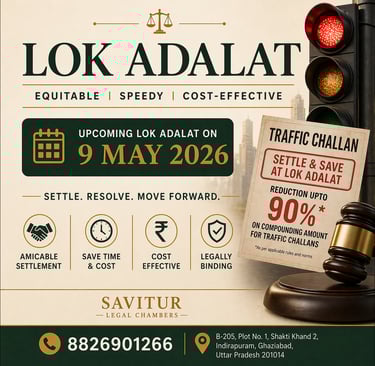
The upcoming National Lok Adalat will cover a wide range of matters across jurisdictions. One area that continues to see significant participation is traffic challan settlement.
In many cases, individuals defer addressing challans due to time constraints or procedural steps. Lok Adalat offers a dedicated platform to address such matters efficiently, without the need for extended proceedings.
Depending on the nature of the matter, participants may experience:
Streamlined resolution
Reduced procedural requirements
Clear and immediate closure
It is important to note that Lok Adalat operates as a settlement forum, and outcomes are based on the specific facts and permissible framework of each case.
Scope of Matters Covered
While traffic challans are a key focus, the scope of Lok Adalat extends to:
Recovery and financial disputes
Utility-related matters
Pre-litigation disputes
Select civil matters capable of settlement
The common principle is that the dispute must be legally capable of resolution through mutual consent.
How the Process Works
The process is designed to be accessible and efficient.
Eligible matters are identified either from pending cases or through pre-litigation registration. Individuals may register in advance or appear at designated Lok Adalat centres, depending on local procedures.
Each matter is placed before a bench comprising a judicial officer and conciliators, whose role is to facilitate dialogue and guide parties toward a mutually acceptable resolution.
Once an agreement is reached, the matter is formally concluded—often within the same day.
A Practical Perspective on Traffic Challans
There is a general perception that Lok Adalat automatically reduces penalties. In practice, outcomes depend on the nature of the violation and applicable legal provisions.
The key advantage lies in:
Timely resolution
Clarity of liability
Avoidance of further procedural steps
For many individuals, this provides a straightforward pathway to compliance and closure.
Strategic Use of Lok Adalat
Lok Adalat is particularly effective where:
The matter is routine or limited in scope
There is willingness to resolve the dispute
Timely closure is a priority
For more complex or high-value disputes, parties may prefer to explore other legal remedies depending on the circumstances.
Conclusion
The national lok adalat on 9 May 2026 reflects the strength of India’s legal system in offering multiple avenues for dispute resolution.
It provides a practical and structured mechanism for individuals to resolve pending matters efficiently, while ensuring legal finality.
Office Address:
Saviturlegal@gmail.com
+91 9625063335
© SAVITUR Legal Chambers 2026. All rights reserved.
Contact:
B-205, Plot No. 1, Shakti Khand 2, Indirapuram, Ghaziabad, Uttar Pradesh 201014