National Lok Adalat – 9 May 2026: How to Settle Eligible Delhi Traffic Challans
Got a pending Delhi traffic challan? The 9 May 2026 National Lok Adalat could be your best official chance to settle eligible cases. Here’s what qualifies and what to do next.
4/27/20262 min read
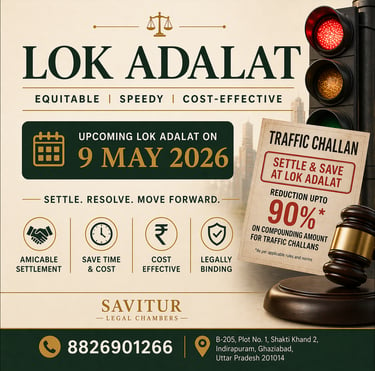
If you have a pending Delhi traffic challan reflected in the court system, 9 May 2026 is a date that warrants immediate attention. The Delhi State Legal Services Authority (DSLSA) has notified that the upcoming National Lok Adalat will be conducted across all district court complexes in Delhi. For traffic matters, it will take up compoundable challans pending on the Virtual Court portal up to 31 January 2026.
For Delhi users, challan slips are expected to be available through the Delhi Traffic Police Lok Adalat portal from 4 May 2026 (10:00 a.m. onwards), subject to operational limits-a daily cap of 50,000 slips and an overall cap of 2 lakh challans.
This is not merely another payment window. A Lok Adalat, constituted under the statutory framework of the National Legal Services Authority (NALSA), is a recognised dispute resolution mechanism designed to facilitate final settlement of eligible matters, including compoundable traffic challans. It offers a structured opportunity to resolve cases efficiently, without prolonged court proceedings.
At the same time, implementation protocols can vary across states. This note is therefore a Delhi-specific legal explainer, and users should rely on verified local notifications where applicable.
What the 9 May Window Means for Delhi Users
For vehicle owners in Delhi, this window is particularly relevant if:
There are pending or older traffic challans
Multiple challans exist across one or more vehicles
The matter has already been transferred to the Virtual Court system
Delay can be counterproductive. The challan slip download process in Delhi operates under strict caps, and access is typically exhausted quickly. A practical approach, therefore, is to:
Verify whether the challan is eligible
Complete necessary steps prior to 9 May
Decide whether to proceed independently or with legal assistance
Which Challans May Qualify
NALSA’s notified categories for 2026 include compoundable traffic challans. However, it is important not to assume uniform eligibility across all offences.
Under Delhi Traffic Police systems, certain violations are processed as regular penal entries, while others are treated as court challans. The classification directly affects eligibility.
Accordingly, the correct legal approach is to verify the challan status on the official portal, rather than relying solely on the nature or description of the offence.
What Should Be Done Before 9 May
The first step is verification through official digital systems. The Virtual Courts platform allows search by:
Mobile number
CNR number
Party name
Vehicle number or challan number
Once located, the user may:
Review case details
Proceed with payment (where applicable)
Request transfer to the concerned court for contest
Where a matter is transferred, the acknowledgement reflects the jurisdictional court and listing date. In Delhi, traffic courts also facilitate virtual appearance, either by the violator or through legal representation.
For the Lok Adalat process specifically, the critical action point remains:
Downloading the challan slip during the designated window starting 4 May (10:00 a.m.)
Given the capped system, early access is not just advisable-it is often decisive.
From a legal and procedural standpoint, the National Lok Adalat on 9 May 2026 represents a time-bound opportunity to resolve eligible traffic challans within a structured statutory framework.

Office Address:
Saviturlegal@gmail.com
+91 9625063335
© SAVITUR Legal Chambers 2026. All rights reserved.
Contact:
B-205, Plot No. 1, Shakti Khand 2, Indirapuram, Ghaziabad, Uttar Pradesh 201014